LuceLoop 26B Fast: 2x faster answers through weight tuning
We are releasing LuceLoop 26B Fast, an independent weight-tuned model by Lucebox built on Thinking Machines Lab's open-weights Inkling 2 Mini. It cuts overthinking at default effort and runs well ahead of published NVIDIA DGX Spark speeds on our open-source ROCm engine.
TL;DR
- Half the tokens, higher accuracy. LuceLoop 26B Fast cuts output tokens by 50.2% and answer time by 2.01x over base Inkling 2 Mini while lifting accuracy to 87.7%, with zero prompt changes.
- General behavior stays intact. Held-out generic prose stays at 0.023 nats KL divergence and 93.4% Top-1 agreement, across independent Apache 2.0 GGUF builds for 16 to 32 GB GPUs.
- 2.2x to 3.6x faster decode than DGX Spark. One Lucebox runs 110.2 to 136.5 tok/s live HTTP (155.4 peak), against dated public DGX Spark vLLM runs of 37.8 to ~60 tok/s.
- Fast prefill and full 262K on one card. Our open-source ROCm engine hits 3,628 tok/s prefill (up to 5.0x
llama.cppon the same R9700) and keeps 262K context inside 32 GB VRAM.
Less thinking through weight tuning: 2.01x faster answers at higher accuracy
Thinking Machines Lab's Inkling 2 Mini stays small on disk by looping its middle 12 layers three times per token. Every extra thinking token pays for those three passes. At default settings it often rambles, so most of the wait goes to thinking.
The obvious fix is lowering reasoning_effort at runtime. That shortens replies, though Classmethod's Nov 21 test saw it drop rules on long system prompts. We fixed it in the weights instead, so the model keeps default effort and gets to the point.
LuceLoop 26B Fast is an independent Lucebox derivative of Inkling 2 Mini, not affiliated with or endorsed by Thinking Machines Lab, shipped as Apache 2.0 GGUFs (with mtp.safetensors) for luce_server and llama.cpp. Below is LuceLoop against base weights across 130 problems on one R9700 (DSpark on, default effort, temp=0.0).
| Benchmark | Accuracy | Wall time | Tokens | Cut | Speedup |
|---|---|---|---|---|---|
MATH-500 test[0:40] | 77.5% → 82.5% | 210.1 → 106.3 s | 25,106 → 12,566 | -50.0% | 1.98x |
HumanEval test[0:40] | 95.0% → 95.0% | 186.5 → 84.5 s | 23,507 → 11,997 | -49.0% | 2.21x |
MMLU-Pro test[0:50] | 80.0% → 86.0% | 271.1 → 141.9 s | 30,864 → 15,024 | -51.3% | 1.91x |
| Combined (130) | 83.8% → 87.7% | 667.7 → 332.8 s | 79,477 → 39,587 | -50.2% | 2.01x |
All three LuceLoop 26B Fast checkpoints are live on Hugging Face under Apache 2.0 at Lucebox/LuceLoop-26B-Fast-GGUF:
| File | Precision | Size | Target hardware |
|---|---|---|---|
LuceLoop-26B-Fast-UD-Q8_K_XL.gguf | Full Dynamic Q8 | 21.3 GiB | Highest precision; fits 24 to 32 GB GPUs and Strix Halo |
LuceLoop-26B-Fast-IQ4_NL.gguf | IQ4_NL MoE + Q8_0 attn/coda/head | 16.4 GiB | Verified benchmark build above (114/130, 2.01x faster) |
LuceLoop-26B-Fast-IQ4_NL-16GB.gguf | Full IQ4_NL | 14.0 GiB | Fits 16 GB GPUs with +17% faster autoregressive decode |
mtp.safetensors | Base DSpark speculator (Apache 2.0) | 607 MiB | Drop beside any GGUF for speculative decoding in luce_server |
Lucebox engine speed vs NVIDIA DGX Spark and same-GPU baselines
Inference engines for a new architecture move daily, so every external result below links to its dated public run. To match published DGX Spark and R9700 baselines, the engine benchmarks below run Thinking Machines Lab's base Inkling 2 Mini weights (one Lucebox: R9700 32 GB + Strix Halo, Q8_0 KV).
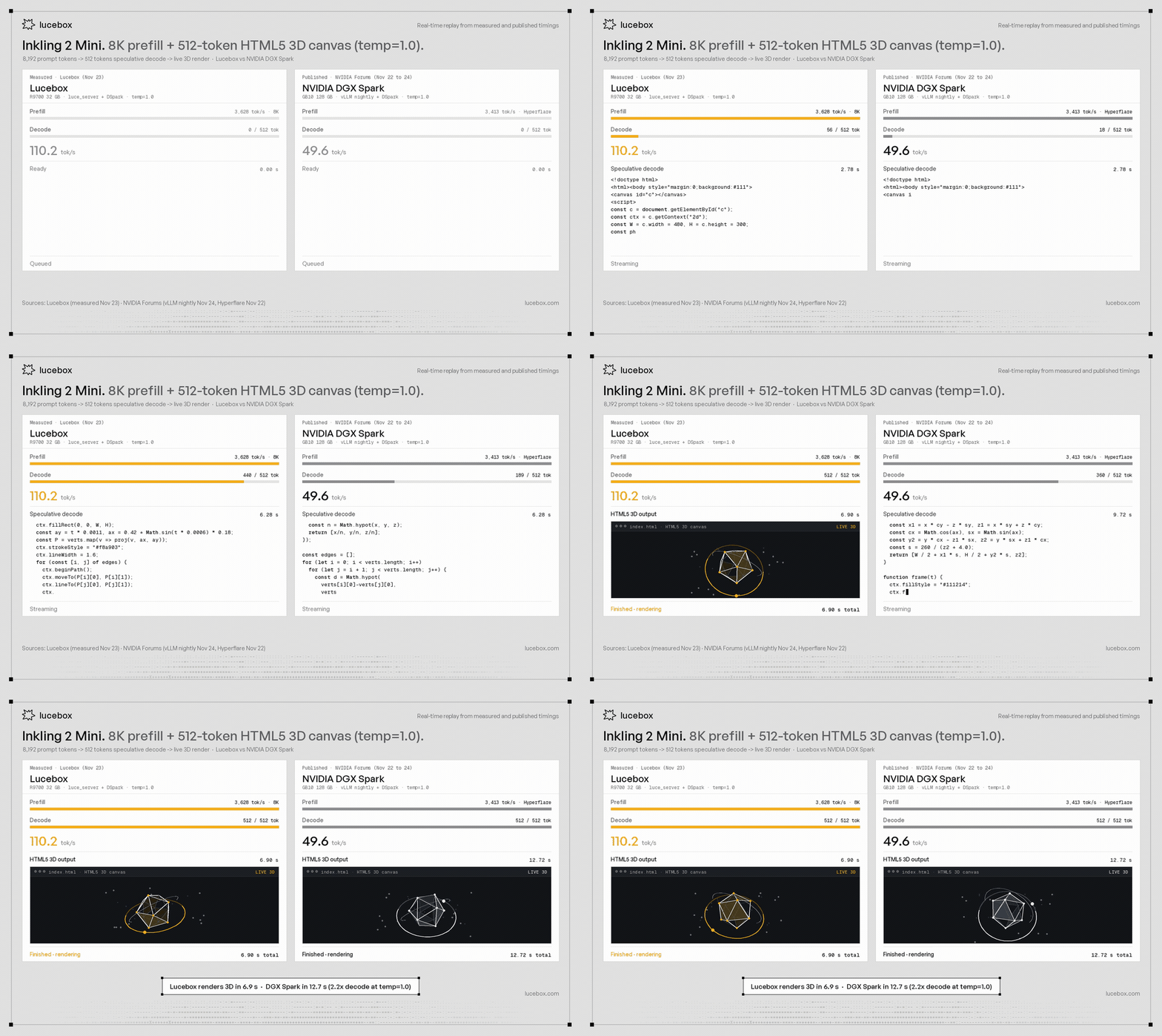
Below, both boxes write a live 3D canvas scene at matched temp=1.0: 6.9 s on Lucebox against 12.7 s on DGX Spark (GIF). The DGX Spark lane pairs published Hyperflare prefill with vLLM nightly decode, since no single public run reports both.
Without speculation, DGX Spark decode hits its 273 GB/s memory ceiling across the three-pass loop, while Lucebox stays at 81.7 tok/s strict autoregressive. Every external bar below comes from a dated public run listed in the table beneath the chart.
| System and engine | Setting | Decode | Source |
|---|---|---|---|
R9700, vllm-redshift | NVFP4, 211-tok prompt | 144.6 tok/s | LocalMaxxing, Nov 23 |
| DGX Spark, vLLM 1K code | NVFP4 + DSpark (~33 AR) | ~60 tok/s | NVIDIA Forums, Nov 23 |
R9700, llama.cpp | UD-Q4_K_XL, AR | 52.8 tok/s | LocalMaxxing, Nov 21 |
| DGX Spark, vLLM nightly | SPEED-Bench, temp=1.0 | 49.6 tok/s | NVIDIA Forums, Nov 24 |
| DGX Spark, Hyperflare | NVFP4, tuned MTP | 42.3 tok/s | NVIDIA Forums, Nov 23 |
| DGX Spark, vLLM recipe | NVFP4 + DSpark, temp=0 | 37.8 tok/s | Classmethod, Nov 21 |
Prefill: 3,628 tok/s flat to 32K, 5.0x llama.cpp on the same R9700
On short prompts, Lucebox matches DGX Spark Hyperflare prefill while beating vllm-redshift and llama.cpp on the same R9700. At 120K tokens, our open-source ROCm engine holds 12.2x the throughput of our matched llama.cpp run.
From 59.3 to 155.4 tok/s on ROCm
Our native ROCm engine climbs from a 59.3 tok/s initial port to 155.4 tok/s peak, all open in Luce-Org/lucebox.
Five workloads and sampled HTTP
Speculation looks best on code, so we also tested five direct workloads and five live /v1/chat/completions runs across temperatures. Even on low-acceptance creative prose, DSpark stays ahead of strict autoregressive decode.
Long context: 16K to 262K inside 32 GB
Inkling 2 Mini's hybrid sliding-window attention keeps a full 262K context resident on one 32 GB R9700 alongside the DSpark drafter. The chart below compares our continuation runs against published DGX Spark Hyperflare llama-benchy sweeps.
Run it
Download a LuceLoop 26B Fast checkpoint and mtp.safetensors from Lucebox/LuceLoop-26B-Fast-GGUF, then launch luce_server. The same GGUF files also load directly in llama.cpp:
# download LuceLoop 26B Fast + DSpark speculator
hf download Lucebox/LuceLoop-26B-Fast-GGUF \
  LuceLoop-26B-Fast-IQ4_NL.gguf mtp.safetensors --local-dir models/luceloop-26b-fast

# single R9700 (32 GB VRAM, up to 262K context)
./server/build/luce_server models/luceloop-26b-fast/LuceLoop-26B-Fast-IQ4_NL.gguf \
  --target-device hip:0 --max-ctx 65536 --port 8080

# dual-GPU (R9700 + Strix Halo)
./server/build/luce_server models/luceloop-26b-fast/LuceLoop-26B-Fast-IQ4_NL.gguf \
  --target-device hip:0 --expert-device hip:1 --max-ctx auto --port 8080
Hardware and cited sources
| Lucebox (measured) | AMD Radeon AI PRO R9700 32 GB + Ryzen AI MAX+ 395 / Strix Halo 8060S 128 GB, ROCm 7.2, base Inkling-2-Mini-IQ4_NL.gguf / LuceLoop 26B Fast (Lucebox/LuceLoop-26B-Fast-GGUF) + mtp.safetensors, Q8_0 KV, measured 2026-11-23 (eval solved counts: MATH-500 31→33/40, HumanEval 38→38/40, MMLU-Pro 40→43/50, combined 109→114/130) |
|---|---|
| DGX Spark, vLLM nightly | GB10 128 GB running vllm/vllm-openai:nightly (0.34.0rc1.dev1163), dgx_spark_gb10 config, 262K ctx, 7-token DSpark, temp=1.0, SPEED-Bench throughput_1k (~1.2K in, 1,024 out), posted by tudor5 on NVIDIA Developer Forums on 2026-11-24 |
| DGX Spark, vLLM 1K code | GB10 128 GB running official NVFP4 weights with vLLM + 7-token DSpark (CPU/GPU capped at 2 GHz, 1K-token code benchmark: ~33 tok/s AR, ~60 tok/s with DSpark), posted by jameslacroix on NVIDIA Developer Forums on 2026-11-23 |
| DGX Spark, Hyperflare | GB10 128 GB running Hyperflare (ignition) on NVFP4/MXFP8 via llama-benchy (pp2048 3,176 to 3,718 tok/s across d0 to d100K; tg1024 35.9 tok/s default, 42.3 tok/s tuned MTP, 28.0 tok/s at 100K without drafter), posted by hiroshiya on NVIDIA Developer Forums (follow-up) on 2026-11-22 to 23 |
| DGX Spark, Classmethod | GB10 128 GB running the official vLLM NVFP4 recipe with DSpark lookahead 7 (262K ctx, 256 tok, temp=0, 37.83 tok/s single-stream), measured by Classmethod on 2026-11-21 |
| Same R9700, other engines | Public LocalMaxxing runs: vllm-redshift (0.34.0+redshift.v0.3.1, NVFP4: 144.6 tok/s decode on 211-tok prompt on 2026-11-23, up to 2,073 tok/s prefill on 2026-11-22) and llama.cpp (UD-Q4_K_XL: 52.8 tok/s / 728.6 prefill on 2026-11-21; 48.6 tok/s / 750 prefill on 2026-11-22) |
LuceLoop 26B Fast is an independent third-party derivative tuned by Lucebox from Thinking Machines Lab's Apache 2.0 Inkling 2 Mini weights. Lucebox is not affiliated with, sponsored by, or endorsed by Thinking Machines Lab Inc.
Bottom line
LuceLoop 26B Fast cuts overthinking inside the weights, delivering answers twice as fast at higher accuracy while keeping general behavior intact. Paired with our open-source ROCm engine, one Lucebox beats published DGX Spark speeds with full 262K context on one card.
Related
- Running DeepSeek V4.1 Flash on the Lucebox memory hierarchy: up to 3x faster with the R9700
- MOSS-Image on the R9700: a 1024x1024 image in 2.7 s at 8 steps, 1.8x faster than ComfyUI on a DGX Spark
- Qwen3.8-27B on the AMD R9700: up to 227 tok/s
Run LuceLoop 26B Fast on Lucebox
Independent weight-tuned Apache 2.0 GGUFs and open-source ROCm inference engine.
Built for Lucebox Zero 495 Hardware specs Order in shop