Inkling 2 Mini Fast on Lucebox: Faster Than M5 Ultra, Half the Answer Time
Inkling 2 Mini now runs natively on one Lucebox at 3,628 tok/s prefill and 136.5 tok/s live HTTP decode (up to 155.4 tok/s): 3.6x faster than an NVIDIA DGX Spark and faster on both prefill and decode than a Mac Studio M5 Ultra. We are also publishing Inkling 2 Mini Fast on Hugging Face (full Q8 and custom-speed 4-bit GGUFs), cutting end-to-end completion time by another 2.01x while raising accuracy from 83.8% to 87.7% across MATH-500, HumanEval, and MMLU-Pro.
TL;DR
- 2.01x faster answers with +3.8% higher accuracy. Inkling 2 Mini Fast (published in full Q8 and custom-speed 4-bit GGUFs) cuts wall-clock time from 667.7 s to 332.8 s across 130 official benchmark problems while raising combined accuracy from 109/130 (83.8%) to 114/130 (87.7%) — with zero prompt changes.
- 3.6x faster than one DGX Spark. In Classmethod's test of the official vLLM recipe on a DGX Spark, single-stream decode is 37.83 tok/s. One Lucebox reaches 81.7 tok/s without speculation and 136.5 tok/s over HTTP with DSpark (up to 155.4 tok/s, 4.1x).
- Faster than a Mac Studio M5 Ultra on oMLX. Against the public oMLX v0.8.3 Python code sweep (64-core 96 GB M5 Ultra, MTP on), Lucebox leads on prefill at every length (3,628 vs 3,332 at 8K; 3,313 vs 3,052 at 32K) and on decode at both
temp=1.0(110.2) and greedy (136.5 vs 80.8 at 8K / 102.5 at 16K). - 5.0x llama.cpp prefill on the same R9700. Public LocalMaxxing runs on one R9700 put llama.cpp at 728.6 tok/s prefill and 52.8 tok/s decode, and vllm-redshift at 1,287 to 2,073 tok/s prefill.
- Full 262K context on one 32 GB R9700. 16K to 262K continuations run at 125 to 150 tok/s completely resident in VRAM — and everything is open source in Luce-Org/lucebox.
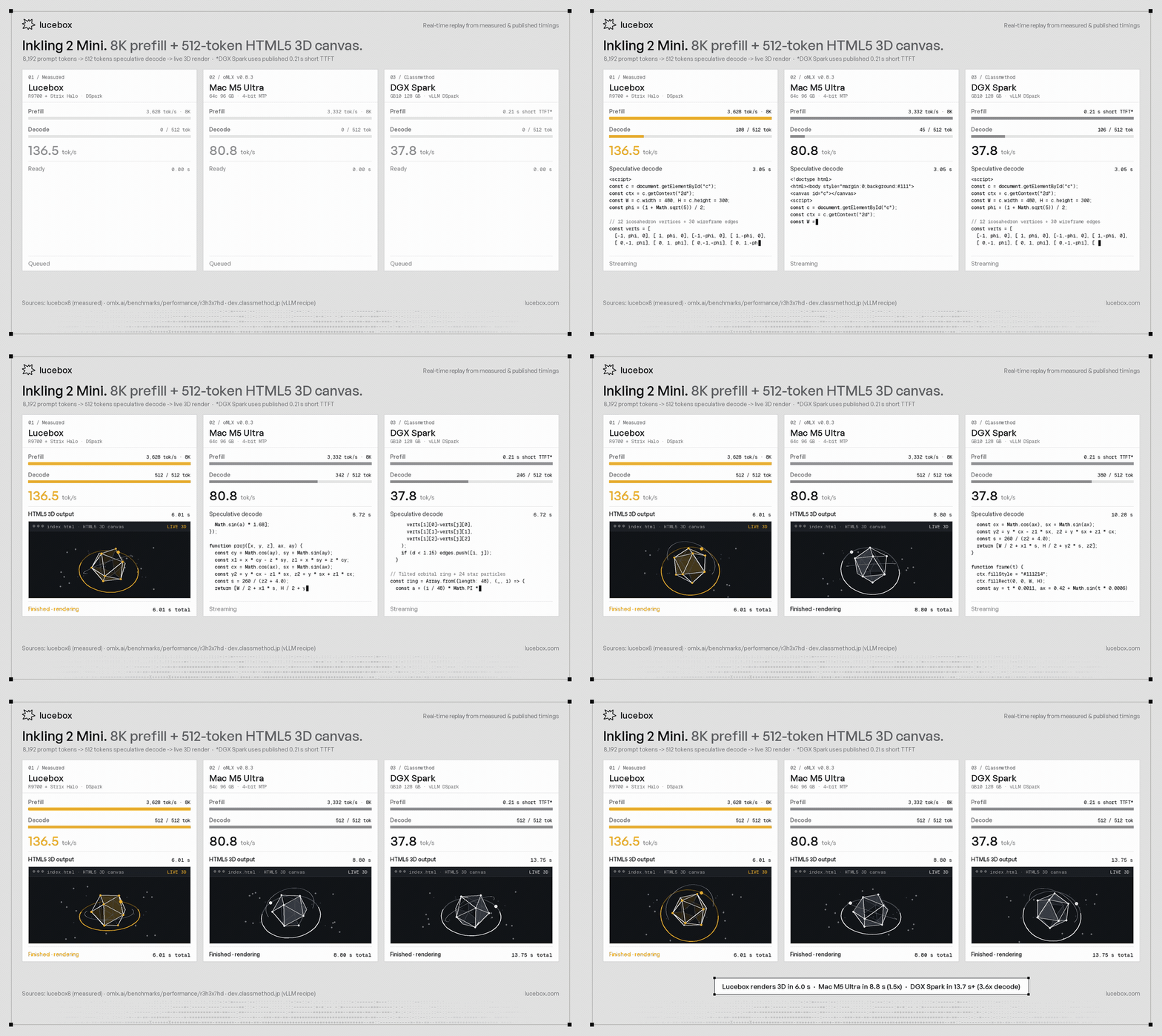
Below, all three machines run an 8K prompt followed by 512 tokens of single-file HTML5 3D canvas code, replayed in real time from measured and published speeds. As soon as each machine finishes writing the code, its panel renders the 3D scene. Classmethod did not log 8K prefill on the DGX Spark, so the Spark column starts decoding after its published 0.21 s short-prompt TTFT; Lucebox still renders first at 6.0 s against 8.8 s on the M5 Ultra and 13.7 s+ on the Spark (GIF version).
Inkling 2 Mini Fast: 2.01x faster answers, +3.8% higher accuracy
Tokens per second are only half of latency; how many tokens a reasoning model burns before answering is the other half. Today we are releasing Inkling 2 Mini Fast on Hugging Face — standard GGUF checkpoints (both full UD-Q8_K_XL and our custom-speed 4-bit builds, bundled with mtp.safetensors) that drop straight into luce_server and llama.cpp with zero prompt or harness changes.
Tested head-to-head on one R9700 (DSpark enabled, default reasoning effort, temp=0.0) across 130 official public benchmark questions, Inkling 2 Mini Fast finishes in half the wall-clock time while solving more problems across competition math, executable Python coding, and unseen multi-domain reasoning:
| Official Benchmark | Baseline (IQ4_NL) | Inkling 2 Mini Fast | Tokens | Speedup |
|---|---|---|---|---|
MATH-500 (test[0:40]) | 31/40 (77.5%) · 210.1 s | 33/40 (82.5%) · 106.3 s | 25,106 → 12,566 (-50.0%) | 1.98x |
HumanEval (test[0:40]) | 38/40 (95.0%) · 186.5 s | 38/40 (95.0%) · 84.5 s | 23,507 → 11,997 (-49.0%) | 2.21x |
MMLU-Pro (test[0:50]) | 40/50 (80.0%) · 271.1 s | 43/50 (86.0%) · 141.9 s | 30,864 → 15,024 (-51.3%) | 1.91x |
| Combined (130 problems) | 109/130 (83.8%) · 667.7 s | 114/130 (87.7%) · 332.8 s | 79,477 → 39,587 (-50.2%) | 2.01x |
On HumanEval, live decode speed also rose from 126.0 to 141.9 tok/s alongside the 49% token drop, cutting total coding wall-clock time by 2.21x. On MATH-500, eliminating overthinking removed all 5 token-cap truncations (5 → 0). And on MMLU-Pro — spanning law, biology, physics, economics, history, chemistry, and philosophy — accuracy climbed by +6.0 points. Grab both the full Q8 and custom-speed 4-bit GGUFs (including a 14.0 GiB build for 16 GB GPUs) from Lucebox/Inkling-2-Mini-Fast-GGUF.
Against Mac Studio M5 Ultra and DGX Spark
Each box runs its own native engine and 4-bit quant, so these are whole-system public points rather than a single-engine A/B test. All Lucebox bars were measured on lucebox8 (Inkling-2-Mini-IQ4_NL.gguf + mtp.safetensors, Q8_0 KV). Mac Studio M5 Ultra numbers come from the public oMLX v0.8.3 Python code sweep (64-core 96 GB, Inkling-2-Mini-oQ4e-mtp, temp=1, MTP on). DGX Spark numbers come from Classmethod's run of the official vLLM NVFP4 recipe with DSpark lookahead 7. EXO Labs also posted a launch demo citing 210 tok/s decode and 3,620 tok/s prefill on a 96 GB M5 Ultra without published flags or prompt details; we plot the reproducible oMLX sweep below.
Prefill: 3,628 tok/s flat to 32K
Our native ROCm engine stays above 3,300 tok/s all the way to 32K tokens — ahead of the Mac Studio M5 Ultra at every prompt length, 5.0x faster than llama.cpp on the exact same R9700 at standard lengths, and 12.2x faster at 120K tokens (2,456 vs 202 tok/s). Curious how it works under the hood? Everything is open in Luce-Org/lucebox.
From 59.3 to 155.4 tok/s
Starting from our initial baseline port at 59.3 tok/s strict autoregressive decode (64.6 tok/s sampled over HTTP), our native ROCm engine pushes live HTTP decode to 125.4 tok/s at temp=0.7, 136.5 tok/s greedy, and 155.4 tok/s peak on one Lucebox (full source in Luce-Org/lucebox).
Five workloads and sampled HTTP
Speculation is easy to flatter with one coding prompt. Below are five direct workloads (256 tokens, greedy) and five live /v1/chat/completions runs using the official chat template at temp=0.0, 0.7, and default 1.0. Even on low-acceptance creative prose, speculation stays ahead of strict AR (83.0 vs 79.8 tok/s).
Long context: 16K to 262K inside 32 GB
Inkling 2 Mini's hybrid sliding-window architecture lets a full 262K context window stay resident on a single 32 GB R9700 alongside the DSpark drafter. On oMLX v0.8.3, the M5 Ultra drops from 102.5 tok/s at 16K to 46.3 tok/s at 128K; Lucebox holds 125 to 150 tok/s from 16K through 262K on continuations.
Run it
Download Lucebox/Inkling-2-Mini-Fast-GGUF (full Q8 or our custom-speed 4-bit builds, with mtp.safetensors bundled) and launch luce_server:
# download Inkling 2 Mini Fast + DSpark speculator
hf download Lucebox/Inkling-2-Mini-Fast-GGUF \
  Inkling-2-Mini-Fast-IQ4_NL.gguf mtp.safetensors --local-dir models/inkling2-fast

# single R9700 (32 GB VRAM, up to 262K context)
./server/build/luce_server models/inkling2-fast/Inkling-2-Mini-Fast-IQ4_NL.gguf \
  --target-device hip:0 --max-ctx 65536 --port 8080

# dual-GPU (R9700 + Strix Halo)
./server/build/luce_server models/inkling2-fast/Inkling-2-Mini-Fast-IQ4_NL.gguf \
  --target-device hip:0 --expert-device hip:1 --max-ctx auto --port 8080
Hardware and setup
| Lucebox | AMD Radeon AI PRO R9700 32 GB + Ryzen AI MAX+ 395 / Strix Halo 8060S 128 GB, ROCm 7.2, Inkling-2-Mini-IQ4_NL.gguf / Inkling-2-Mini-Fast-GGUF + mtp.safetensors |
|---|---|
| Mac M5 Ultra | 64-core 96 GB Mac Studio running oMLX v0.8.3 on Inkling-2-Mini-oQ4e-mtp (4-bit, MTP on, Python code, temp=1), 2026-11-23; separate launch demo by EXO Labs |
| DGX Spark | GB10 128 GB running the official vLLM NVFP4 recipe with DSpark lookahead 7 (262K ctx, 256 tok, temp=0), measured by Classmethod on 2026-11-21 |
| Same R9700 | Public llama.cpp (UD-Q4_K_XL) and vllm-redshift (NVFP4) runs on LocalMaxxing |
Bottom line
One Lucebox runs Inkling 2 Mini at 3,628 tok/s prefill and 136.5 tok/s live HTTP decode (155.4 peak): 3.6x faster than an NVIDIA DGX Spark and faster on both prefill and decode than a Mac Studio M5 Ultra on oMLX. Pair it with Inkling 2 Mini Fast and end-to-end completion time drops another 2.01x while accuracy rises to 87.7% across MATH-500, HumanEval, and MMLU-Pro. Both the engine and the models are open source.
Related
- Running DeepSeek V4.1 Flash on the Lucebox memory hierarchy: up to 3x faster with the R9700
- MOSS-Image on the R9700: a 1024x1024 image in 2.7 s at 8 steps, 1.8x faster than ComfyUI on a DGX Spark
- Qwen3.8-27B on the AMD R9700: up to 227 tok/s
Run Inkling 2 Mini Fast on Lucebox
Open-source ROCm engine and 2x faster GGUF checkpoints.